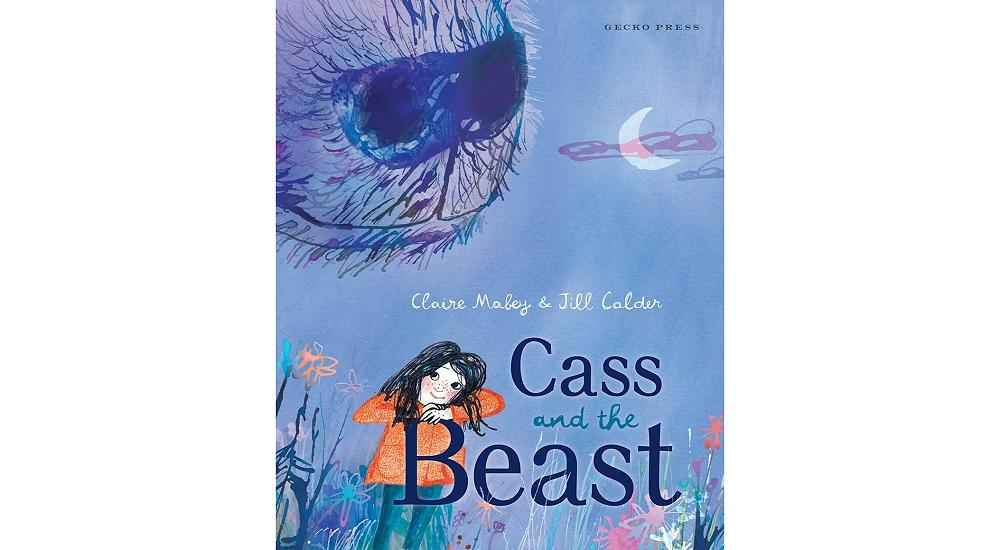
'Cass and the Beast' by Clare Mabey and Jill Calder (Gecko Press, 2026)
By Clare Mabey | Posted: Friday Sep 18, 2026
Here's a great Q&A with Claire Mabey, author of Cass and the Beast, on the CLPE UK website.
Cass and the beast: A blog by Clare Mabey | Centre for Literacy in Primary Education
Order your copy here: Cass and the Beast | Gecko Press
What inspired you to write this book?
I was sitting down at my writing desk one morning and Cass just popped into my head. I wrote down the whole story in one go. When I got to the end I sat back and wondered where on earth Cass had come from! Her voice, her character, her intentions and actions were all very clear. So clear that in fact when I tried to tweak a few elements of the story later on, she said, “NO!” (I’m sorry I tried to change your name, Cass. It will never happen again.)
Sometimes I think stories are brewed in our subconscious and when they’re good and ready they’ll swim to the surface and make themselves known. Cass was like that for me. I can see how elements in the story are familiar preoccupations of mine: bravery, the wild, stories, deciding what is true and what is right, making up your own mind, home, night, and apples.
When I was growing up I always heard stories about my Aunty Margaret who died when she was only nine years old, of cancer. The stories about her always included how she was extraordinarily brave and sweet and kind. I only knew her through stories and through old sepia photos in which she’s always smiling. I think my Aunty’s story sank into my bones and so when I came to write Cass I had this image of a brave, smiling girl facing an unknown and very frightening story of her own. For my Aunt it was illness and then knowing she wasn’t going to be alive for very long. For Cass, it’s the idea of the beast. What is that unknown? What will happen if she faces it with empathy and curiosity?
I’ve always always been fascinated by the wild: wild landscapes, wild animals, wild children, wild ideas, wild feelings. To me this is a story about departing from the safety of home (Cass has a lovely kitchen) and into the wide world where nothing is predictable or particularly safe, either. The adventure Cass has is all due to her wonderful capacity to take in the unknown. I mean, it could have gone horribly wrong. But she followed her instincts and met the beast with all she had: her heart, her piece of bread, and her curious little mind.
How would you suggest primary teachers use this book?
I think Jill Calder’s illustrations make this a book to marvel at. There is wild potential here to create beasts! To think about what elements a monstrous being might have: is all as it appears? How does language conjure ideas? How do those ideas need to be interrupted and surprised?
I also think there is a very strong theme of the night. All of the action takes place over a night in the light of the silver moon. How does the world change at night? What colours transform? What emotions does the night evoke? How does moonlight play a part in atmosphere and adventure?
There is also potential to look at figurative language. I wanted to fill this book with luxurious language that would surface words, lovely words, and provide scaffolding for the world of pictures. How might a beast breathe? What do houses look like in the dark?
Finally, is there a way to use Cass’s story as a way to explore what we are afraid of? What stories do we simply accept? What stories need a little more investigation? How can we make sure that we know our own minds? Cass doesn’t want anyone else to tell her what to be afraid of and I think that’s a terrific way to be in the world.
What motivated you to begin a career in writing?
I have been writing for as long as I can remember. Plays for my siblings and I to perform to our parents and anyone else who had the patience for them, long epic poems, short stories, many attempted novels, some fairly excruciating poetry. But I didn’t make a proper go of writing as a career until after I had my son. There was something about having a baby that made me realise that unless I committed to it, and right now, I never would. So I went and signed up to a course called Worldbuilding with one of my favourite writers Elizabeth Knox. In that class 14 of us designed a world and each wrote three chapters of the story. By the end we had a novel. It was the most fun! I loved every second of it. After the course was over I didn’t stop writing; I couldn’t. Then, one afternoon, a character popped into my head as ready as anything. She was 11 years old, determined, quite angry and more than a little worried. She turned out to be the star of my first novel, The Raven’s Eye Runaways, about a world where reading and writing are restricted to a privileged few. What a nightmare! I had such fun writing Getwin’s story. So much that I wrote a sequel, The Raven’s Eye Rebellion (I love revolting children).
I love writing because I love reading. The sensation of being immersed in a story and meeting the fascinating people in them always gives me energy. I look forward to my writing days every week and they always go far too fast!
What are the major influences in your work and how do you decide on your subjects?
I don’t tend to identify subjects when I’m writing but do see recurrent themes popping up across my work so far: I’m very interested in stories (obviously) – in the way some narratives are harmful and some helpful. How do we encourage critical thinking? How do we find our instincts? How do we locate our own sources of magic? What kinds of magic are there? Are adults always right? No!
Even though I’m primarily a fantasy author I’m influenced by real-world politics. I remember as a child coming to the realisation that the adult world did not, in fact, always do the right thing. In fact, the grown-up sphere often seemed to act against all of my values! That was painful. I’m interested in that moment of realisation and often explore that in my stories: children who must stand solid in their values when all around them the system is failing those values.
I’m also lucky to live in a very wild part of the world surrounded by trees, a rugged coastline, curious birds, and whipping winds. I get a lot of ideas simply by taking a look outside.
Which books had a lasting impact on you as a child and why?
I have been an avid reader my whole life which I think helps when it comes to writing. It’s interesting to me that when I did finally commit to writing it was children’s literature that came naturally to me. I think that’s because it was over the ages 10 - 12 that I read the most immersively: I lived inside books, travelled through them, became friends with characters, and began to expand the boundaries of my world.
It’s hard to isolate individual books from so many but I owe a great debt to Brian Froud. I owned all of his faery books: every single one. And still do! They still make me shiver and see another realm, just out of reach. I also owe a great debt to Margaret Mahy who is one of the greatest ever writers for children and young adults. Mahy brought me witches, and comedy, and play with language, and an acute understanding and compassion for the position of children in an adult world. Her picture books The Lion in the Meadow, The Boy with Two Shadows, Jam, The Man Whose Mother Was A Pirate … they formed the foundations of worldbuilding for me from a very young age. From there it was her novels The Haunting, The Tricksters, Dangerous Spaces, The Changeover and Catalogue of the Universe (in particular – there are many more) that showed me how to go deep into the experience of a character and find their own special magic, their fears, the transformations that take place when story happens to them.
Another New Zealand writer who had an enormous impact on me was Maurice Gee. His Halfmen of O trilogy (The Halfmen of O, The Priests of Ferris, Motherstone) were my favourite books for a long time. They’re essentially about totalitarianism, religion, colonisation: huge ideas! But so deftly told – not a word is wasted. I have such vivid images of those books and know they shaped my worldview in profound ways.