A Conversation with Nicole Flattery - CISS Irish Writing Fellow 2025
By S. A. Arleyn | Posted: Friday Dec 12, 2025
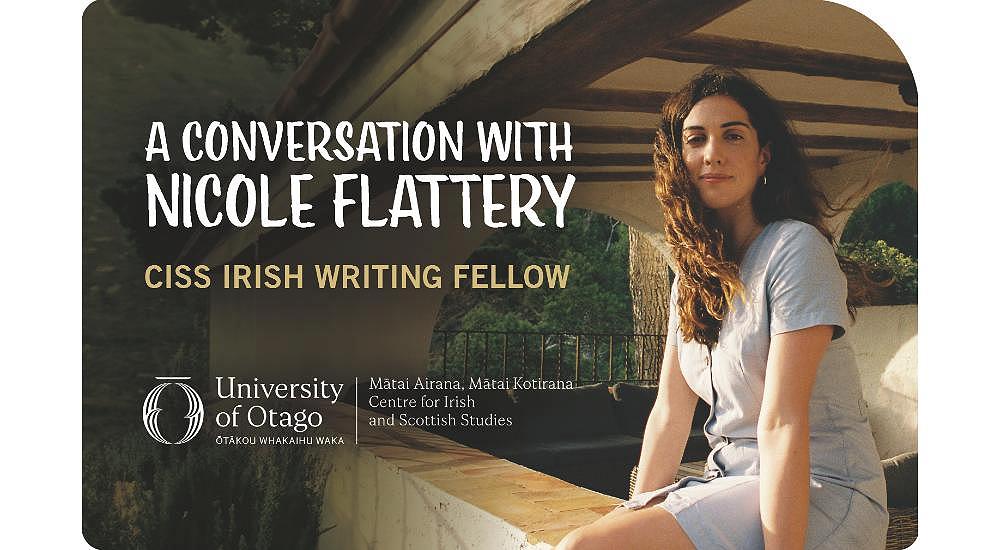
Earlier this year, Dunedin Public Libraries and Ōtepoti UNESCO City of Literature had the joy of hosting young Irish author Nicole Flattery, in conversation with Professor Maebh Long, the Eamon Cleary Chair of Irish Studies at Ōtākou Whakaihu Waka University of Otago’s Centre for Irish and Scottish Studies.
Having just travelled to Aotearoa for her fellowship with the Centre, Nicole’s self-aware wit and writerly know-how made for a nuanced and freely flowing discussion of women’s labour, the enveloping pull of the big city, and finding dark lyricism in the everyday.
Nicole Flattery comes from a small Irish town, and knows how to write about being overwhelmed. The 36-year-old Kinnegad native moved to Dublin to study film and theatre at Trinity, and the experience lent her a sort of signature: to source the darkly eerie within swarming and unfamiliar spaces. After the success of her first short story collection Show Them a Good Time, Nicole penned a full-length novel, Nothing Special, and was soon recognised — among many other accolades — with a writers’ residency at Otago’s Centre for Irish and Scottish Studies.
Professor Maebh Long, who co-chairs the Centre and has an expansive writing resume herself (look for The Parish Review), opened the discussion with an invitation for Nicole to read an excerpt without further delay. She responds with the first page of the first short story of her first book. There’s something magnetic about the confidence to just dive right in, but the tone of the page she reads isn’t sparkling; it’s uncertain and full of dark corners. “Management interviewed me, bizarre questions through an inch of plexiglass,” she reads. “How long, in hours, have you been unemployed? Did you misspend your youth throwing stones at passing cars?”
This short piece focuses on a young woman being placed in a slightly too-sinister work environment — a gas station that has no real need of her — while a bored, bureaucratic force breathes heavily over the proceedings. Nicole explains:
We were in recession after the Celtic Tiger period of economic growth, and there was a lot of unemployment amongst young people. There was a jobs-grade scheme set up to get young people back to work, with totally ridiculous jobs. And I was like, what's the furthest you could push this for a story?
The result is a fluorescent, liminal waltz of tedium, wit, and concrete flooring:
The interview was an all-nighter, designed to break my spirit … management left the room as I screened the demonstration video. In it, three participants with the sexist good looks of catalogue models spoke of the joy of being back at work. Whenever they did something spontaneous or something considered outside their remit, a large X popped up on screen. As I watched, I felt giddy and ashamed.
This haunting cynicism follows us into her new novel as well. Nothing Special, published by Bloomsbury in 2023, delves into the dissociative experiences of Mae, a young typist transcribing Andy Warhol’s tapes and memorabilia into his book a, A Story. As she slowly becomes consumed by the intricate layers of the lives she writes about, Mae starts questioning the purpose of her own, and if her identity will show through in the project. While Nicole’s signature themes of liminal spaces and women’s labour remain, the setting is vastly different to her previous work. She told Ali Boyne in an earlier interview for Dunedin Public Libraries’ NB:
I just sort of wanted the challenge. I wanted to do something entirely different and outside of myself after the story collection, and I hit upon this idea.
Nicole likes to write about what goes on behind the scenes, but she says that in Nothing Special the sense of hidden space runs deeper than that. Towards the end of the discussion Maebh asks her about her treatment of Warhol as this unseen, almost legendary figure in the novel. Nicole explains:
It’s a good power move. He was very good at making himself unassuming and sort of uninteresting, yet still having a tremendous amount of power…
She references a quote from Warhol on the fear of the recorder replacing his own presence:
The acquisition of my tape recorder really finished whatever emotional life I might have had, but I was glad to see it go. Nothing was ever a problem again, because a problem just meant a good tape.
Maebh notes that it opens up a whole new argument, about whether we can be replaced with what we record, rather than simply being credited for it; an uneasy kind of territory. Nicole nods,
[It’s a very] contemporary idea. I wanted to look at it through this lens.
Towards the end of the interview, Maebh brings up the specific, devastating moment when Mae realises she isn’t going to be credited:
She thinks that she will be on the cover, thinks that she's going to be an author. But she's not, and she finally has to go and buy a copy herself, and she's nowhere to be seen. There's absolutely no trace of her involvement.
Maebh looks questioningly at Nicole.
You’re playing with the idea of labour there, the difference between ... transcribing and authorship … Where do you lie on what she did?
Nicole says,
Well, we’re so fascinated by the idea of genius [but] it requires so much to prop it up. And so many people in the background doing endless amounts of work to never get anything for it. There’s a lot of trauma. A lot of women’s trauma. I don't feel like there was any respect sort of given to them.
Nicole admits that some people have said to her that they found it anticlimactic that Mae never becomes an artist or author herself, and continues her life quietly out of the spotlight. But Nicole doesn’t see this as losing.
She maintains her sense of self. [And] I just wanted to show that this idea — our traditional notions of success — I don’t agree with it. She’s able to move on. And those small things are not a life misspent or a chance missed. In a way, her life was far superior.
-S. A. Arleyn, for Ōtepoti He Puna Auaha Dunedin UNESCO City of Literature