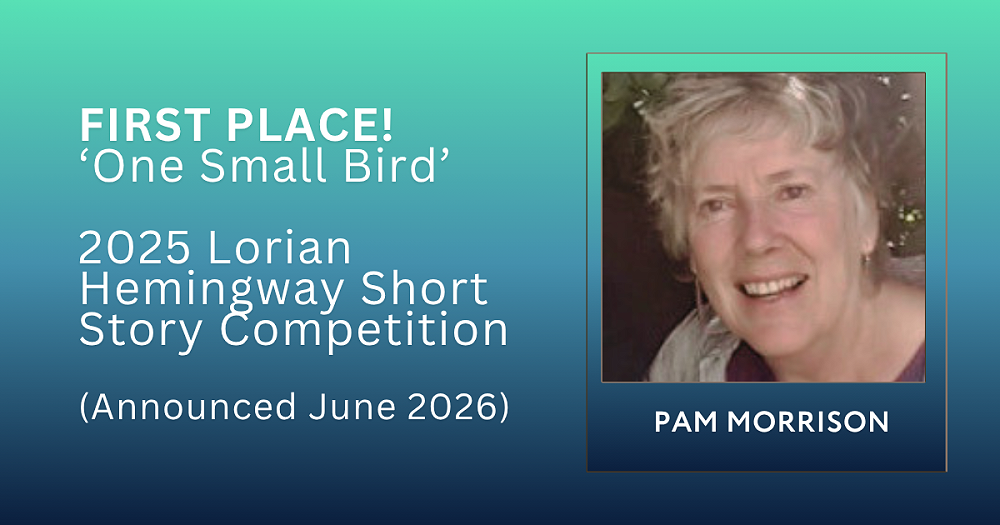
One Small Bird
By Pam Morrison | Posted: Monday Jul 06, 2026
FRIDAY
The daughter
Orange leaves, yellow leaves, bright as crayons, shining up at her. That’s why Evelyn has turned her willow stick from a magic wand into a broom. Here she comes, twirling the twig ends and whooshing the leaves into a swirl of colour. But now at the lamppost just past the dairy she’s come to a stop. The stick has fallen and she’s crouching, looking down. She’s lost her clip and her fringe is falling over her eyes. She doesn’t care. She bends lower, shifting off her ankles to kneel on the gravel. A snag on her paisley leggings sends a ladder snaking over her knee. The leaves are deeper here and there’s sludge over the blocked drain. That’s not why Evelyn is bunched over like a comma. She’s seen something.
A round bunch of feathers, the colour of her hair.
The mother
She stands in the doorway. Her face tightens over her jaw, her cheeks. She scans the girl’s small body. The run in her new leggings. That impossible slip of hair. Her little finger like a grubby wishbone, tucked under a mangled wing. So what now Evelyn? The thought ricochets. Silence, the best control. She watches her daughter lay the bird on a bunched singlet in a small white box. And now her daughter’s hands are dipping inside the cardboard, out of sight. They could be stroking that bruised little carcass. The mother is unable to enter, unable to leave. She’s aware of her own hands, how her fingers are knotting across her midriff. Her stomach has started to ache.
The daughter
Her mother has gone and no-one is looking. The bedroom door is closed and her turquoise duvet, her two pillows and her unicorn cushion are heaped against it. The venetian blinds stick, but they’re at least half shut. Lines of light, skinny as long plaits, stream over the stripped bed, across the tumble of shoes and onto the small dark-stained wooden stool with the small white box on top.
The father
The car windows are shut tight as if the noise trapped in his chest might be heard by someone out there on the esplanade. He can feel its edges, a clamped fist. That visit to his mother. Her chair as usual, pitched at a lean, her mouth slack. He couldn’t bear to look in her eyes today. Not after yesterday. Her eyes so desperate, as if begging for release. Motor neuron disease had her by the throat. How apt is that, he thinks, now that her words have gone, her saliva the enemy that’s likely to kill her. His tears would do the same. He watches the waves crash and pull.
The mother
First the apron around the neck, the waist, then the pink latex gloves tugged up the fingers of each hand, then the smoothing, rubber on plastic, down her front from neck to thigh. Uniform in place, she’s back. As if back to herself, she thinks, after retreating from her daughter’s bedroom door. She learned the lesson a long time ago that busy hands keep a clean domain, inside and out. Keep them still and things can get messy. Her hands are deep in soapy water, scrubbing the oven tray, when she sees the car pull up. She lifts them out of the sink, her gloved fingers elongating, The suds hang like stalactites as she watches her husband walk around his car towards her front door. She waits for his shoulder to shudder then fall back into line. It always does. She feels her mouth twitch like it’s charged by the same electrical current.
The father
The garage door where he parked the car has rusted shut. Leaves are piling against it, as if nature’s attuning to the mess and clutter inside. The venetian blind in the bedroom is half closed. Another job not done. His shoulder tightens. He resets it with a shake while he walks the path to the shut front door. He knows what’s about to come from his wife. Nothing. No hello. No how was your day. Evelyn’s different. And here she is. Running to him, taking his hand in hers. He feels its smallness, its aliveness. Her name means little bird. How right they were to choose it for her. ‘Come and see what I found daddy’. He follows her into the bedroom past the bed to a small white shoe box sitting on a low dark stool. He looks inside, sees a black fist of feathers.
The daughter
She takes her father’s pointer finger between her forefinger and thumb and guides it down into the white box. ‘Stroke his head daddy. Now his front. Can you feel it? The little puffs of breath?’
SATURDAY
The daughter
Evelyn hasn’t slept in her bed. Instead she plumped the duvet and pillows into a heap and slept on the floor as close as she could to the bird. She’s moved the pile a little further away now the sun’s up and is smoothing her white bottom sheet over the pile, tucking under the elastic corners. She has a good view of the white box and can see the top of the bird’s head; its black, glossy head. She tips back her forehead, runs her fingers through her hair, stroking back all of the strands, the long bits and the short bits. She pulls the sheet-covered bedding up around her, above her eyes. Only the black top of her head is showing. Her breath is slow now. On each outbreath she makes a soft whistle. A single note.
The mother
She can’t bear the thought of the supermarket, the people, the noise, and has pulled up a block away beside the sports field. Perhaps it’ll pass. A pigeon has landed on the bonnet of the car. How maddening. It’s turning its head like a hand puppet, entranced by a streak of light dancing on the metal sheen. Fury breaks out in her hands. She leans on the horn until the car is screaming at the bird. A dog barks, then another. The bird spreads its wings and slowly lifts off. A throng of pigeons rise up from the field and join the bird. She watches them move together like a scarf caught in a fanciful wind, no care for the dot of her way down here. Just doing what they do in unison, sailing over her this way then that way. She’s feeling light-headed, as if something has dislodged and lifted. Something so new she can’t name it. Oh god.
The father
He’s briefly confused that his wife’s not carrying any shopping bags but he’s not about to ask, and the thought is momentary. He wants to get out of the house and he needs the car keys. She slides them along the slippery bench before he has time to speak, and he wonders why she’s so keen to see him go. Usually she resents it, operates on go-slow, even though this one weekly outing to his mother is all she knows about. He knows what’s getting him moving. He can’t get it out of his mind. He has touched a dying bird. He has stroked the shell of its small bony head, and with Evelyn’s help, has put his finger to its chest, its tiny panting chest. On the road now, he feels less afraid. Strangely less alone. He pictures Evelyn with him, helping him open the door into that airless room, at his side as he takes his mother’s dry hand in his own. Today yes, he will stroke her thinning hair, look in her eyes, perhaps not lose himself in the darkness he sees there.
The mother
She’s outside emptying the rubbish when she looks across. The blind is still half closed. She feels a ripple of relief. Is she glad there’ll be no demands coming at her? Or is this relief for her daughter’s sake? Surely that’s it. Cuddling up to that bird, it’ll teach her a lesson for life. Dying is ugly and death is brutal. She bangs the bin lid shut. A pain shoots across her wrist
The father
There’s no-one around to see the spring in his step when he gets home, but here he is hunting through the tools and implements that litter the two back corners of the garage. He knows what he needs and smiles as he works through the tangle – it’s like pick up sticks in Evelyn’s shrunk the kids movie. The rake comes loose, and now he’s out the side door, holding the splintering wood handle and its battered head in front of his body like a lighted torch. He starts where his foot meets the lawn, dragging leaves into a pile across the sodden grass. Soft swish becomes scratch as he crosses onto asphalt, pulling the rake in a straight line in front of the garage roller door.
The mother
Finger by finger she pulls off her pink gloves, drops them like old skin onto the stainless steel bench. The apron sways on its hook as she opens the door to outside. She keeps thinking back to the morning. The bird and the birds. The feeling that came after. A breeze meets her head on, cools her neck and chest, rides down her forearms. She sees from the door frame what she doesn’t ever seem to see through the glass in the kitchen window. How the elm and willow have shed most of their leaves. How the branches look naked and exposed, yet somehow steady, even beautiful, with their leaves skittering beneath them. She sees her husband, backlit by the late afternoon sun, dancing with something that looks like a broom.
The daughter
She’s put in a hairclip to keep the peace, and perhaps it’s working. She feels her mother smoothing her hair like she used to, with one stroke. She can’t believe her mother missed the other thing. Evelyn found it just before dinner tucked into the singlet in the box. She knows it’s a gift, so she and the bird can stay close when she has to leave the bedroom. She feels the sharp quill tucked in behind her ear, the soft pressure of the splay of black feather mingling with the glossy black of her own hair.
SUNDAY
The father
He’s been awake since just after 5 o’clock, planning it out. The old pallets, the hacksaw and hammer, the brackets that must be somewhere in that box of sundries he came across yesterday. He hauls out the parts and tools just after sunrise, puffing steam into the cold air. He’s knows where it needs to go. Out of sight behind the garage. It’s years since he took on a project like this, and he doesn’t want anyone to see him working on it when his hands, his arms too, feel so awkward.
The daughter
It could be any time of day in the mushroomy shadow of her room, thanks to the blanket she’s draped over the window. The clock says 8.07am, but she’s not looking at the clock. She’s gazing into the black eye of the bird. The black eye of the bird is gazing back at her. She feels the mirror in her chest taking in the eye. A small black moon, cool and calm inside her. She knows what she must do next. The shiny button from her best coat. The coin her mother brought back from Singapore before she married dad. Grandma’s butterfly brooch. She arranges them around the bird, like she’s seen in the Egypt book. She takes her bright blue bottle of rose water, small as her little finger, sprinkles sweet smelling drops from its tiny cracked cork then lays the bottle on its side close to the wing. One more thing. She snips a lock of her own hair. There. The eyes of the bird are getting dimmer. The single eye in her chest, no longer cool, is glowing.
The mother
Sunday is deep clean day but she finds herself distracted. There’s blurry movement outside the kitchen window and she wipes an arc through the steamed up glass with her open hand. It’s Evelyn fossicking over by the twisty willow tree. She looks completely absorbed. A good thing perhaps. That she’s left the bird behind and is busy entertaining herself outside. An unfamiliar warmth comes like a wave. She frees up her body with a shake, runs her hands down the length of her stiff apron.
The daughter
She’d rolled up the sleeves of her blue cardigan after just a few metres but now she’s pulled it right off, flung it sideways. There it is in the cool damp grass, an untidy heap under a bunch of red berries. She’s inching past the rowan toward the twisty willow, her bare arms hauling the garden seat with the curly cast iron legs. Its turned-out feet gouge a thin furrow in a wobbly line as she pulls, pauses, pulls, pauses. Stops. She nudges the seat into place, not too close, not too far from the small dark patch between the protruding tree roots. She shakes her sore hands and feels her arms, relieved of pressure, rise up like wings.
The father
Yesterday’s leaf pile is no longer at the mercy of the breeze. It has four rough-hewn wood sides around it. He’s in a green canvas chair behind the garage, not so much admiring the box, more thinking about what he’s done for the leaves. Now they can rot together, become nothing, then become something else. Something good. He’d been relieved to be out of sight when he was hammering but turns his head when he hears his daughter calling. He sees her small hand reach toward him when she comes around the corner at the back of the garage. He takes it silently with grace, like someone chosen for the next dance.
The mother
Her gloves are still on when Evelyn takes her hand. She feels her daughter’s slight fingers thread through her own then tighten, making sure the gloves stay on while she’s guided to the door away from the bench. She says nothing, just hears her own shoes, how they squeak on the kitchen floor, clack on the concrete path, then quieten as she is led over the grass. She doesn’t ask herself how come. This new thing of being able to follow behind. Trusting, like someone who’s blind.
The daughter
She knew to fold the bird into her doll’s purple crochet blanket. You could see glints of silver through two of the holes, a sliver of blue glass through another, and here and there, the sheen of black feathers. This is what she wants. Her mother and her father are where she led them, sitting together on the garden seat. Her father has a small heap of leaves on his lap. Her mother has peeled off her gloves and is waiting for her turn, cupping her hands to receive the leaves that will come from the hands of her daughter.
The mother, the father, the daughter, the bird
The bird is in place. Evelyn nods to her parents. Nothing is said but they know what to do next. Hold the leaves between both hands, stand up, walk to the edge of the tiny grave. Evelyn starts to drop her leaves. Her parents, side by side, do the same. A cascade of yellow and orange floats onto the soft purple wool, the black soil, the nearly hidden bird. There is a faint aroma of roses.
Pam Morrison is a Dunedin-based former journalist who has turned her hand to writing poetry, flash fiction and short stories. She has been published in journals and anthologies and has been placed in two international flash fiction competitions. Her book, Fields of Gold, co-written with her sister following her sister’s terminal diagnosis, was published in 2014.